
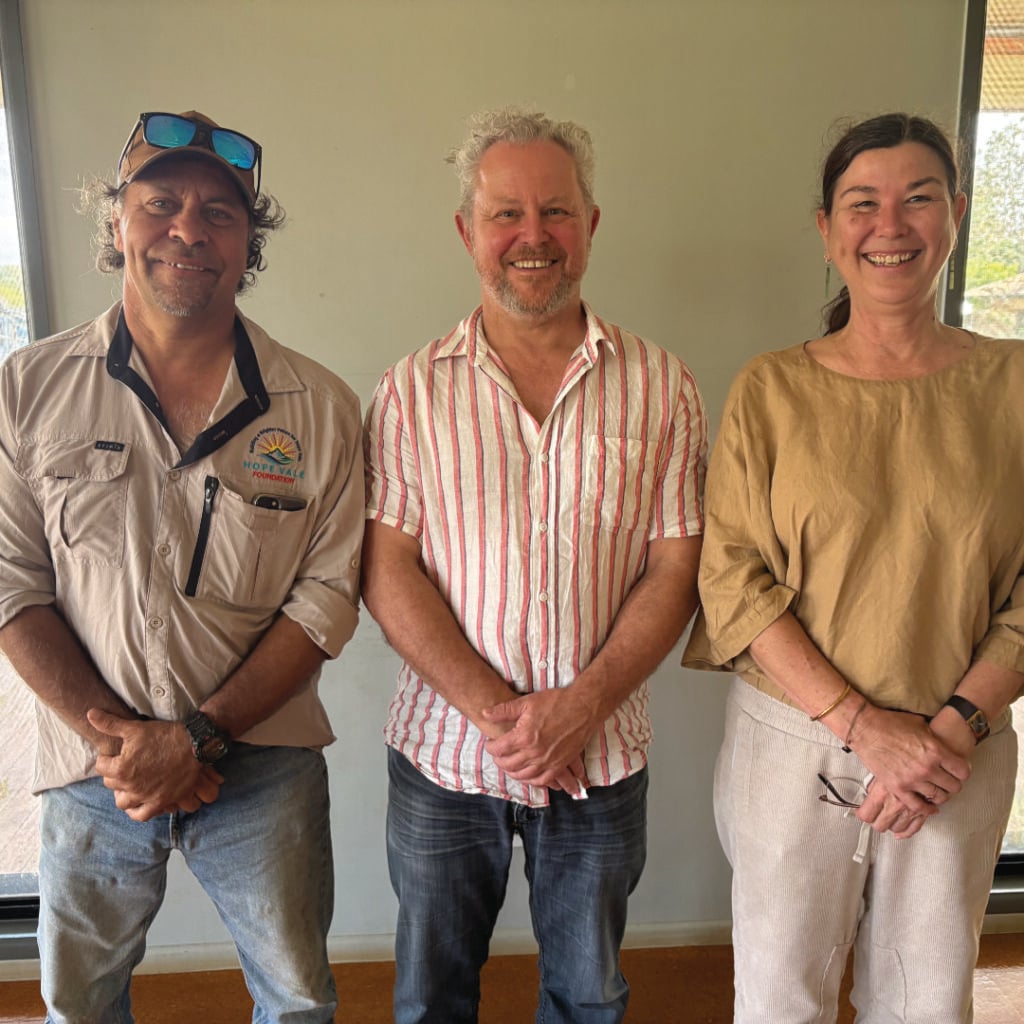
Hope Vale Foundation directors and staff attended an informative meeting last week with Sam Gordon of Blue Agrifood Advisory, who outlined the feasability study’s progress to date. The meeting also provided an opportunity to introduce Dr Peta-Marie Standley, who has joined Hope Vale Foundation as Interim General Manager, through a part-time consultancy.
Hope Vale Foundation is exploring a farming model that brings together 1giant freshwater prawn production, food growing, and employment opportunities, with community priorities guiding its development.
Sam Gordon is undertaking a commercial feasibility study to assess how the proposed project could operate sustainably and generate enough income to support itself.
For Sam, the community’s priorities are central to that work: providing nutritious food and creating pathways into employment.
The proposed model would connect prawn farming with the production of Indigenous and non-Indigenous food crops. Nutrients from the prawn ponds would support plant growth, with water circulating through the system and returning to a reservoir.
“You’re trying to replicate a natural cycle, where the outputs from producing one food (prawns) become the input to produce another food (plants), and recycle clean water to the start of the system,” Sam said.
This approach links different forms of production so that nutrients from one part of the farm become a resource for another. Sam describes it as an approach inspired by natural cycles and traditional integrated farming systems.
The aim is to develop a small-scale, low-intensity operation—establish what works and build from there.
An initial project outline has been prepared. The next step is to seek the Hope Vale Foundation Board’s feedback and guidance, with broader community consultation proposed following Board approval.
Further feasibility work would examine construction and operating costs, potential income and opportunities to involve government agencies, universities and other interested partners.
Sam also sees opportunities for younger community members to develop practical skills and take on leadership roles. During his first visit, he observed increasing numbers of young people attending and actively participating each day.
Looking ahead, a successful local model could potentially be adapted across Cape York, and in other parts of northern Australia. A hatchery could also supply young prawns for stocking additional ponds.
“One exciting aspect of this project is that we are simplifying modern aquaculture, which builds resilience in the system,” Sam said.
For now, the focus is on community guidance and careful planning: establishing a workable model that supports local food production and employment, with room to grow.
1Giant freshwater prawns, also known as Cherabin, are native to northern Australia and offer potential as a valuable food product that can support local jobs and economic opportunities.
